
The biggest nightmare in marketing is not the lack of website visits at all. The biggest nightmare is hundreds of website visits from which there is not a single phone call, not a single email, and not a single sale. This situation usually happens when you optimize your business for the wrong keywords.
For local service businesses, choosing phrases to promote is much simpler than for nationwide e-commerce stores, but it still requires a bit of strategy. How do you create a list of keywords that will realistically drive your business? It’s enough to combine three elements.
Formula: Service + Location + Intent
Local queries in the Google search engine (so-called long-tail keywords or local intent keywords) have a specific structure. Most often they look like this:
[What the customer wants to do/fix] + [Where they want to do it]
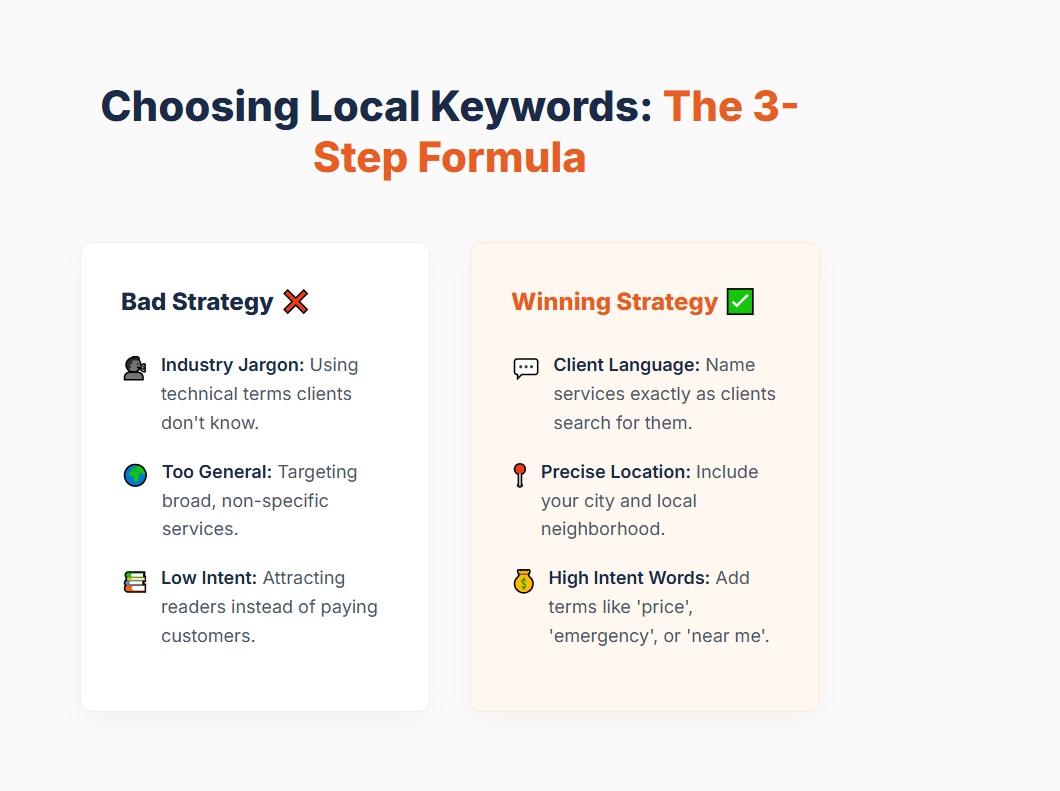
Step 1: List what you do (but in the customer’s language!)
Make a list of your services, but note: list them as your customers call them, and not as they appear in industry directories or on an invoice.
– Wrong: “Restoration of passenger vehicle paint coatings”.
– Right: “Car paint polishing”, “car scratch removal”, “paint correction”.
Instead of positioning for “general construction services”, break it down into specifics: “tile laying”, “bathroom renovation”, “wall skimming”.
Step 2: Add Location (Macro and Micro)
Here we enter the area of local SEO. Add the city where you operate to your services (Macro).
Example: “Bathroom renovation Poznan”.
But that’s not all! If you operate in a large city, remember that people often look for services close to their home. Use neighborhood names (Micro).
Example: “Bathroom renovation Poznan Rataje”, “Tile laying Winogrady”.
Competition for phrases with neighborhood names is microscopic, and a customer typing in such a phrase is extremely determined to find someone “around the corner”.
Step 3: Use High-Intent Keywords
There is a difference between someone who types into Google “how to remove a scratch from a car” and “car scratch removal price Wroclaw”.
The first one is looking for free advice (you can serve them with a blog post). The second one has their wallet in hand and is looking for a service provider.
Add words to your phrases that indicate a desire to make a transaction or an urgent need:
– Emergency (e.g., “emergency plumbing Krakow”)
– Price list / Price (e.g., “paving stone laying price list Gdansk”)
– 24/7 or Fast
– Near me (customers use this word in maps, so Google Business Profile optimization is crucial here).
Tools That Will Help You
You don’t have to guess. Where to get ideas from?
1. From Google Auto-complete: Type your main service and city into Google (e.g., “Accounting Bydgoszcz”) and see what Google itself suggests in the bar (e.g., “Accounting Bydgoszcz price list”, “Accounting Bydgoszcz Fordon”).
2. From customer inquiries: Read last month’s emails. What words do customers use to describe their problem?
3. From free tools: Use tools like Google Keyword Planner, Ubersuggest, or AnswerThePublic to check how often a given phrase is searched.
Summary
Choosing local keywords is the foundation. If you optimize your homepage for “Bathroom Renovations [Your City]” and create separate subpages for smaller services (“Sanitary installation [Your Neighborhood]”), you will capture the warmest traffic from the search engine. People who don’t want to read – they just want to pay for a solution to their problem.