
This is a dilemma faced by every business owner outsourcing the development of a website: whether to put all services on one long subpage called “Offer”, or to create a separate subpage in the menu for each service (e.g., “Full Accounting”, “Simplified Accounting”, “HR and Payroll”)?
From a designer’s (and budget’s) perspective, creating a single “Offer” page is easier and cheaper. From the perspective of Google positioning (SEO) and customer convenience – it’s a huge mistake that will cost you hundreds of lost inquiries. Why is that?
The SEO Argument: Google indexes pages, not entire websites
When a potential client types “air conditioning installation Gdynia” into Google, Google’s algorithm doesn’t look for a general “construction company website from Gdynia”. It looks for a specific, specialized subpage that 100% answers this query.
If you have all your services listed in bullet points on one page:
1. Air conditioning installation
2. Ventilation
3. Heat recovery ventilation (Recuperation)
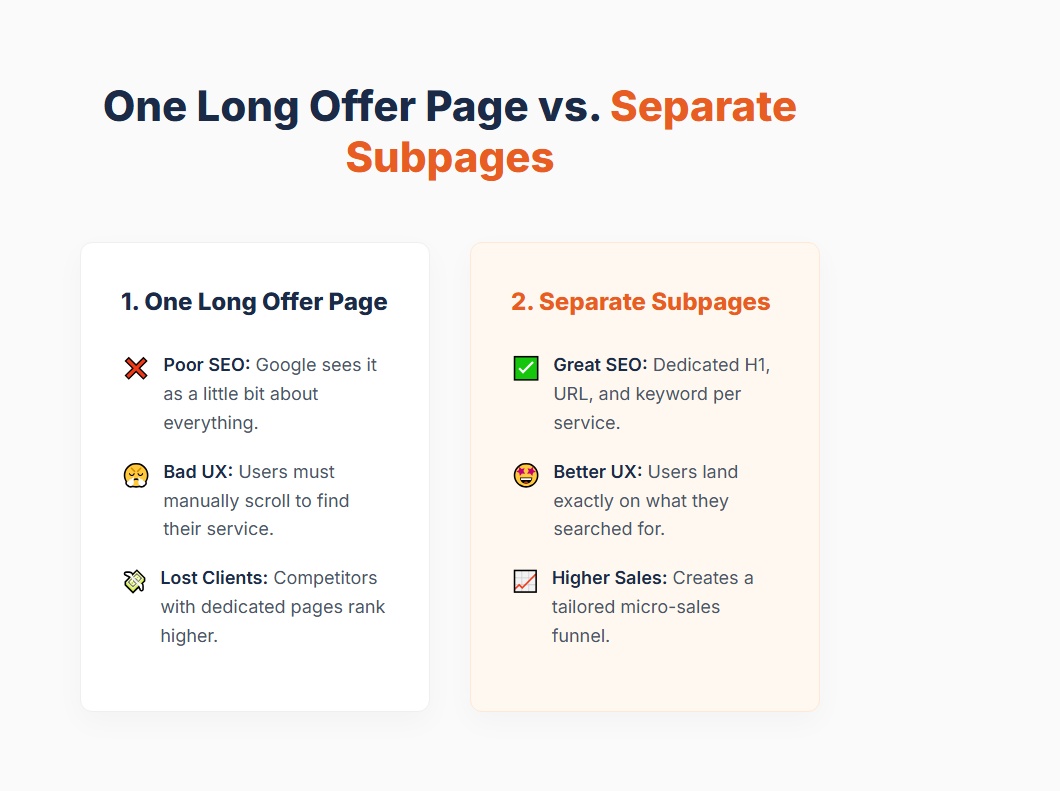
Then, for Google, your page is “a little bit about everything”. The algorithm will consider it less valuable than a competitor’s page that has a dedicated subpage titled (in the H1 heading) exclusively “Air Conditioning Installation Gdynia”, complete with a described process, photos, and a price list. A separate subpage gives you the opportunity to assign a unique title, URL address, and description for one specific keyword phrase.
The UX Argument (User Convenience): The law of least effort
From the client’s perspective, landing from a search engine on the main “Offer” page, where they have to manually scroll through 15 different services (which don’t interest them) to find the right one, is annoying. The modern internet user is lazy. They are looking for an immediate answer.
If they search for “HR services”, they want to click on a link, land on a subpage titled “HR Services”, read what they will gain, see the price, and click “Write to us”. Breaking services into separate subpages allows you to build a micro-sales funnel tailored to the client’s specific problem.
Does every little thing really require a separate subpage?
No. Going to extremes is also harmful. If you are a mechanic, you do not need a separate page for “left headlight bulb replacement” and “right headlight bulb replacement”.
Apply a simple rule:
Create a separate subpage on your business website for each service category that people objectively and actively search for on Google.
- If you have a beauty salon: “Hybrid manicure” needs a subpage (people search for this), as does “Eyelash extensions”. But the add-on “Removal of old hybrid polish” can just be a point in the price list on the “Manicure” page.
- If you are a lawyer: “Divorces”, “Inheritances”, “Criminal cases” are separate subpages (separate groups of problems).
Summary
Dividing your offer into separate subpages is the absolute foundation of good SEO and effective sales. It allows you to precisely match your message to the client’s needs, makes it easier to measure the effectiveness of ads (you can direct campaigns to a specific service rather than the homepage), and gives Google a clear signal: “We are experts in this field.” Do an audit of your website and check if your most profitable services have their own dedicated home on the web.