
Most owners of local service businesses share the same dream: the phone rings regularly, there is no shortage of customers, and the business grows without constantly running in circles. The reality can be different – mostly because marketing is treated reactively, i.e. “we do something when we lack customers”. To change this, you need to start with one step: diagnosis.
This article will guide you through an honest assessment of your company’s current marketing situation and help you choose the first actions that make sense – instead of jumping on everything at once and doing nothing well.
Why “let’s do social media” is a bad starting point
When a business owner decides it’s “time for marketing”, one of a few phrases usually comes up: “we will set up a fanpage”, “we will run an ad on Facebook”, or “we will make a new website”. All these actions can be right – but only if they stem from a prior analysis.
Without a diagnosis, you are acting blindly. You could spend thousands on Google Ads aimed at people outside your service area. You could build reach on Instagram while your clients are only looking for you through referrals from friends. Good marketing starts with the question: what is actually working and what isn’t in my business right now?
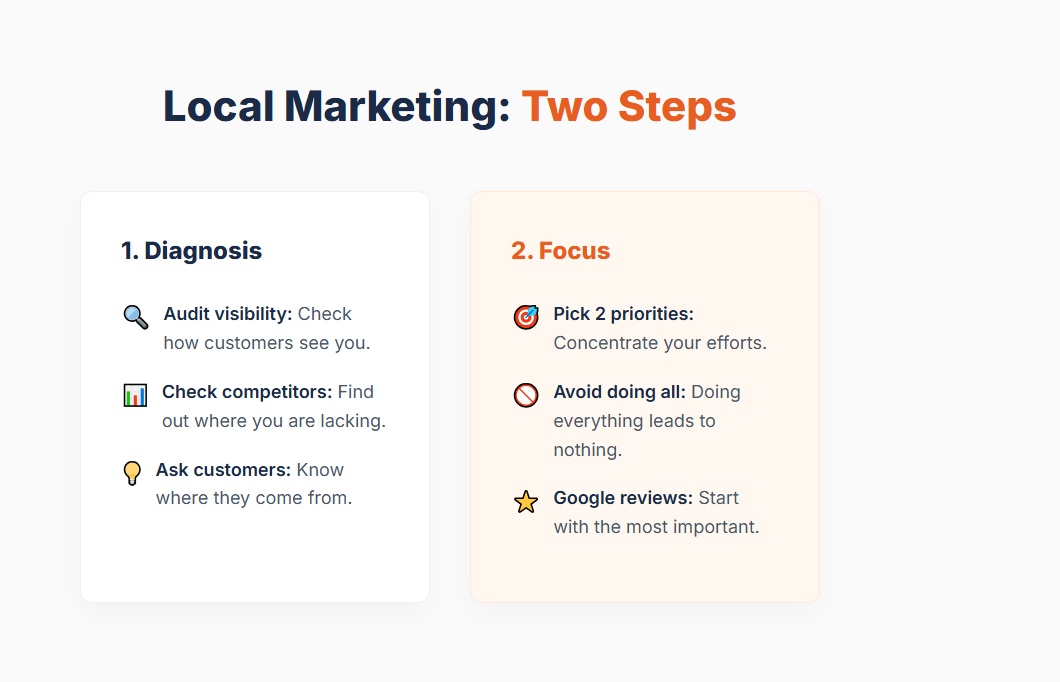
Step 1: Check where your customers are currently coming from
This is the simplest and most important exercise. For the next week, ask every new customer: “Where did you hear about us?”. If you don’t have new customers – ask regular ones how they first found you.
Most common sources of customers for local service businesses:
- Referral (family, friends, previous customer)
- Google (organic results or Google Maps)
- Bulletin boards / local portals
- Paid advertising (flyers, banner, Google Ads, Facebook Ads)
- Social media (fanpage, Instagram)
- Long-term presence / local brand (“I’ve known them for years”)
The results of this exercise might surprise you. Most local service businesses live on referrals – and this is great news, because it means you have satisfied customers. But it’s also a signal that you are completely dependent on one channel that cannot be scaled.
Step 2: Evaluate your online visibility
Your potential customer sits down in the evening, types “plumber Chicago” or “beautician London” into Google – and what do they see? Go into incognito mode now and check yourself.
Online visibility checklist:
- [ ] Do you have a Google Business Profile?
- [ ] Does the profile have up-to-date hours, phone number, and address?
- [ ] Do you have at least 10 Google reviews? What is the average rating?
- [ ] Does your website appear for local phrases?
- [ ] Are you visible on Google Maps in the top 3 local results (the Local Pack)?
A Google Business Profile is the most important free marketing tool for a local business. Studies show that over 70% of users searching for a local service click on map results – before they even reach a website.
If you don’t have a profile or it’s incomplete – this is your number one to-do after reading this article.
Step 3: Analyze your local competition
Go to Google Maps and search for your service in your city. Check the top 3–5 companies that appear above you:
- How many reviews do they have?
- What is their average rating?
- What do their websites look like?
- Do they run social media? How active are they?
The goal of this exercise is not to copy the competition, but to understand the standard you must achieve or exceed so the customer chooses you over the neighbor on the list.
If a competitor has 80 reviews with an average of 4.8, and you have 5 reviews with an average of 4.2 – you know exactly where the gap is. Reviews are the currency of trust today. Customers read them just as carefully as a referral from a friend.
Step 4: Define your ideal customer
Marketing to “everyone” is marketing to no one. A local service business that precisely knows who its ideal customer is can communicate with them much more effectively and cheaply.
Ask yourself:
- Who is your best (most profitable and least troublesome) customer?
- How old are they? Where do they live? What do they do?
- What fears do they have before using your service?
- What made them choose you?
The answers to these questions are a ready-made brief for any marketing message – a Facebook post, website text, or flyer content.
Step 5: Choose one or two things and do them well
After the diagnosis, you have the full picture. Now comes the moment when most business owners make a classic mistake: they want to do everything at once. The result? Nothing is done properly.
Instead, choose a maximum of two priorities for the next 60–90 days. How to choose them?
If you don’t have a Google profile or it’s incomplete → start with a Google Business Profile. This gives the fastest results and is 100% free.
If you have few reviews → launch an active review collection system. After every completed service, send the customer a link to Google asking for a rating. One SMS a week can change your profile in 2 months.
If you have a website but nobody visits it → handle local SEO or launch a Google Ads campaign targeting your area.
If customers come mainly from referrals → strengthen this channel. Create a simple referral program (e.g., “for every referred customer – $10 off your next service”).
If you have an active base of past customers → remind them of yourself. An e-mail or SMS with a seasonal offer to people who already trust you works many times better than an ad to a cold audience.
How do you know if your actions are working?
Local marketing can be measured, even if you don’t have advanced analytical tools. It’s enough to monitor a few simple metrics every month:
- Number of calls/inquiries (how many were there this month vs. the previous one?)
- Number of new Google reviews
- Number of profile views in Google Business Profile (free statistic in the panel)
- Number of new customers and their source
Summary
Marketing a local service business doesn’t have to be expensive or complicated. However, it requires systematic and conscious decisions. Before you spend a dollar on advertising, spend a few hours on diagnosis: where your customers come from, how you look online, and where your biggest gaps are.
Companies that grow steadily don’t do everything at once. They do a few things consistently and well. Your local marketing can start today – by completing your Google profile and sending one review request to a satisfied customer.