
You have a beautiful website, but nobody visits it? Sounds familiar. Millions of websites on the internet struggle with the exact same problem. The solution is called positioning – and although the word sounds technical, its principle of operation is quite logical. In this article, we explain from scratch what SEO is, how it works, and why it can be more important for your business than any advertisement.
What is website positioning?
Positioning, also known by the English abbreviation SEO (Search Engine Optimization), is a set of activities aimed at improving the visibility of a website in search engine results – primarily Google, which controls over 90% of the search market in Poland and globally.
Simply put: when a potential customer types “custom furniture manufacturer London” or “plumber New York” into Google, you want your website to appear as high as possible on the results list. Users rarely click through to the second page of results – the first three organic results collect over 70% of all clicks.
Positioning is not paid advertising (Google Ads). It’s organic traffic – free, long-lasting, and much more credible in the eyes of users.
How does the Google search engine work?
To understand SEO, you first need to know how Google processes websites. The process consists of three stages:
1. Crawling
Google sends bots (so-called “spiders”) all over the web to visit pages and collect information about their content – texts, links, structure, loading speed. If a bot cannot access your page (e.g., due to technical errors), your site simply does not exist for the search engine.
2. Indexing
The collected information goes to Google’s gigantic database – the index. A page must be in the index to appear in search results at all.
3. Ranking
When a user enters a query, Google searches the index in a fraction of a second and ranks pages according to hundreds of ranking factors. At the very top are those that – according to the algorithm – best answer the user’s query.
The three pillars of SEO
Professional positioning is based on three mutually complementary areas:
On-Page SEO (content optimization)
This is everything that happens directly on your website:
- Keywords – phrases that your potential customers are searching for. They must appear naturally in the content, headings, and page descriptions.
- Content – Google rewards valuable, expert content. The more detailed and reliable you answer users’ questions, the higher you can rank.
- Meta tags – the page title and description (meta description) visible in search results. Although they do not directly affect the ranking, they determine whether the user will click on your result at all.
- H1–H6 headings – the structure of the document helps Google understand what the page is about.
- Images – should have descriptive file names and
altattributes.
Off-Page SEO (domain authority)
Google treats links pointing to your site as “votes of confidence”. The more valuable, thematically related pages link to you, the higher authority your domain gains.
- Link building – acquiring backlinks from other sites.
- Brand mentions – even without a link, the appearance of the company name in context builds its recognition.
- Social media – activity on social media does not directly affect the ranking, but it generates traffic and increases the chance of getting links.
Technical SEO
Even the best content won’t help if the site has technical problems:
- Loading speed – Google officially takes Core Web Vitals into account. Slow site = lower positions.
- HTTPS – encrypted connection is now a standard and one of the ranking signals.
- XML Sitemap – helps Google bots effectively crawl the entire site.
- URL structure – short, descriptive addresses (e.g.,
/services/logo-design) are better than/page?id=123. - Mobile-first – Google indexes pages primarily in the mobile version.
How long does positioning take?
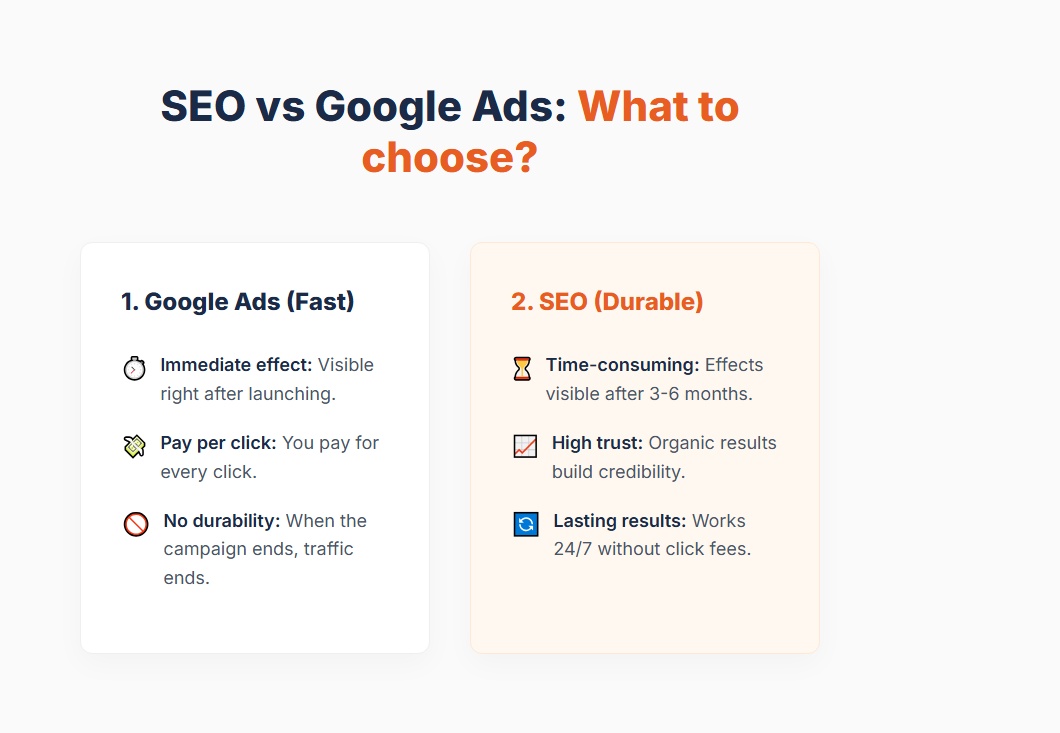
This is one of the most common questions – and one of the hardest to answer. SEO is a marathon, not a sprint. The first effects are usually visible after 3–6 months of regular activities. Full results for new pages may appear only after a year or longer.
Why so long? Because Google must:
– index the changes on your site,
– collect data on user behavior (CTR, time on page, bounce rate),
– assess whether the new content and links are credible.
This is why SEO is treated as a long-term investment – but one that over time brings results without a constant advertising budget.
SEO vs Google Ads – what to choose?
You don’t have to choose – the ideal solution is a combination of both. But if you had to bet on one:
| SEO | Google Ads | |
|---|---|---|
| Time to results | 3–12 months | Immediate |
| Cost | One-time/monthly investment | You pay for every click |
| Durability | Effects remain after actions end | Traffic ends with the campaign |
| User trust | Higher (organic results) | Lower (marked as “ad”) |
| Scalability | Grows over time | Depends on the budget |
If you care about quick results (e.g., seasonal promotion), choose Google Ads. If you are building the company’s long-term presence on the web – bet on SEO.
Where to start?
If you are just starting your adventure with positioning, here are five steps to start:
- Do a website SEO audit – use free tools (Google Search Console, Screaming Frog, Ubersuggest) to identify technical problems.
- Find keywords – think about what phrases your customers are searching for. Google Keyword Planner and Ahrefs are great tools.
- Take care of the content – every subpage should answer a specific question or need. Create a blog, guides, FAQ.
- Take care of technicalities – speed, SSL, responsiveness, and correct structure are the foundation.
- Build links – start with local business directories, cooperation with industry portals, and social media.
Summary
Website positioning is one of the most effective channels for acquiring customers in the long term. Unlike paid ads, a well-positioned website “works” for you 24 hours a day, 7 days a week – without additional costs for each click.
SEO requires patience, consistency, and knowledge. But companies that invest in positioning from the beginning of their online activity have a competitive advantage after a year or two that cannot be bought with any advertisement. Your website can be one of them.