
Many business owners live with the belief that marketing ends the moment a user clicks on an ad or search result and visits their website. It seems that since they are already here, they will definitely send an email or grab the phone. However, the reality is brutal: out of 100 people visiting a typical service website, on average only 2 to 5 of them make contact.
What happens to the other 95 people? Where do they disappear? To understand this, you need to step into your potential customer’s shoes and trace what marketers call the customer journey. It’s not one simple step. It’s a process full of doubts, searches, and verification.
Here is exactly what happens in the head (and on the screen) of your customer before they decide to click the “Send inquiry” button.
Step 1: First impression (The 5-second test)
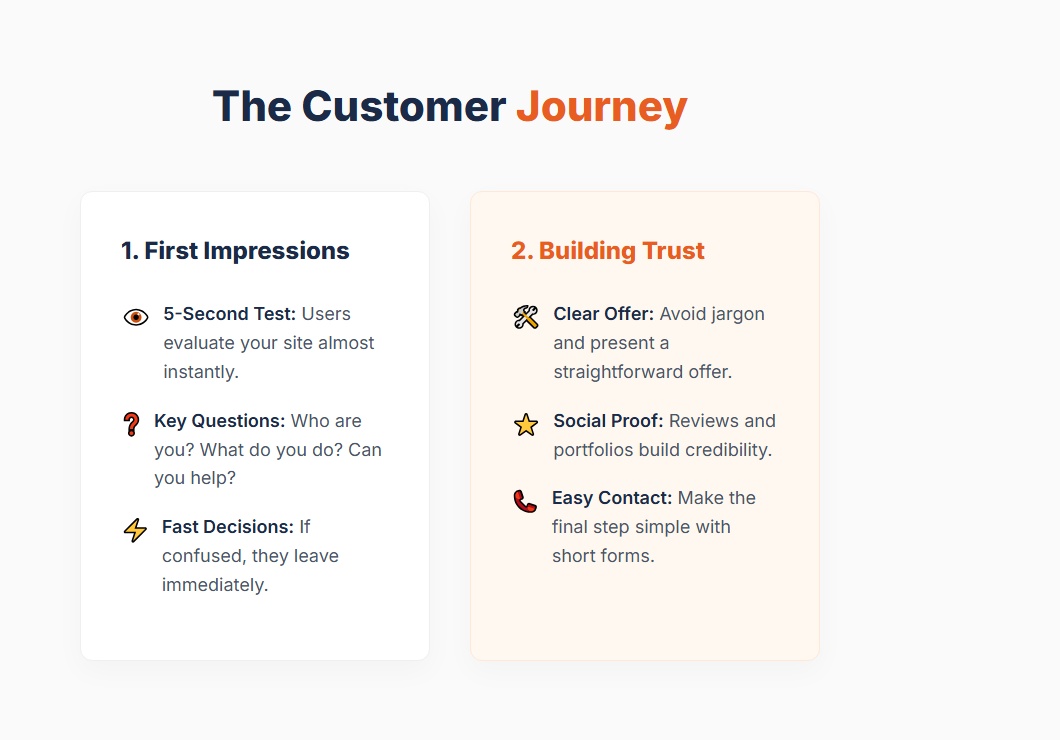
The customer clicks the link. The page loads (hopefully quickly, because if it takes longer than 3 seconds, 40% of people will close it immediately). At this moment, the “5-second test” begins.
Within these few seconds, the user’s brain subconsciously evaluates the page and looks for answers to three basic questions:
1. Where am I exactly?
2. What does this company do?
3. Does this solve my problem?
If your headline reads “We have been a market leader since 1998”, the customer gets none of these answers. They are confused. Instead, you should write specifically: “Comprehensive bathroom renovations in Poznań. Contact us for a free quote”.
At this stage, the customer doesn’t read the texts. They scan them. They look at the quality of photos, overall design, and layout. If the website looks outdated or unprofessional, the customer’s brain automatically links this shoddiness to the quality of your services. The result? Closing the tab and moving to the competition.
Step 2: Verifying the offer (Will they help me?)
If the first impression was positive, the customer stays. They start scrolling the page. They are looking for confirmation that your company does exactly what they need at this moment.
At this stage, the customer is frustrated by the use of industry jargon. If they are looking for someone to repair a roof, and you write about “optimization of bituminous coatings using polymers”, the customer will feel stupid and run away. They want to read: “We will locate and repair any leak using materials with a 10-year warranty”.
The user clicks on the “Services” or “Offer” tab. They browse the available options. They want to know what the cooperation process looks like (do they have to prepare anything, how long will it take) and roughly – how much it will cost. Companies that hide their price lists or price “brackets” out of fear of competition lose a massive amount of inquiries at this stage from customers who simply prefer clear situations.
Step 3: Building trust and social proof
Ok, the customer knows that you offer what they are looking for. But… why should they choose you? After all, you are not the only company in the city. At this point on the customer journey, the need to verify trust arises.
How does the customer do it? They look for so-called social proof.
- They check the “About us” section. They want to see if there are real people behind the company, or just fake stock photos with American smiles.
- They look for a portfolio/completed projects. They want to see the effects of your work. “Before and After” images work wonders here.
- They read reviews. And not necessarily the selected ones pasted on the website as text (because anyone can fake them). Very often, the customer leaves the website, opens Google, and types “your company name + reviews” to check your Google Maps business profile.
- They look for logos. If it’s B2B services, they check who you have worked with so far.
If you don’t serve these proofs to the customer on a silver platter (e.g., in the form of a Google reviews widget directly on the website), you force them to look for them on their own. And every moment the customer leaves your website drastically lowers the chance that they will return to it.
Step 4: Comparison with the competition (Tab juggling)
Remember that your customer rarely opens just one website. They usually open the first 3, 4, or 5 search results in separate tabs. At this stage, they already have your website and your competitors’ websites open.
Now the comparison begins. How do you stand out?
If your website says the same thing as the competitor’s website (“We are professional”, “Experienced team”, “Individual approach” – these are the most popular, empty platitudes), then the customer is left with only one selection criterion: price. And competing solely on price is a road to nowhere.
Your message must be unique. Maybe you give a longer warranty? Maybe you are the only ones who clean up after the renovation? Maybe you reply to inquiries in 30 minutes? Whatever it is – it must resonate strongly on the website.
Step 5: Contact (The home stretch)
The customer has made a choice. They want to ask about the offer. They go to the “Contact” tab. It would seem that nothing can go wrong now. Wrong!
This is exactly where many companies unnecessarily build walls. What discourages the customer on the home stretch?
– A hidden phone number or the inability to click it on a smartphone.
– An e-mail address that cannot be copied (e.g., inserted as an image out of fear of spam).
– A contact form with 15 mandatory fields (Social Security Number, job title, company name, state), while a phone number and a brief description of the problem would be enough to prepare a quote.
– Lack of information about what will happen after submitting the form (“Will they call back in an hour, or in a week?”).
The form should be as short as possible, and underneath there should be a micro-text reassuring the customer, e.g., “We reply within 24 hours on business days”.
Summary
The customer journey is not a single click, but a series of small decisions. The customer must first feel that they are in the right place (the 5-second test), understand the offer, trust you (social proof), decide that you are better than the competition, and finally – easily make contact.
Your website is not supposed to be just a pretty business card. It’s supposed to be your best salesperson who patiently guides the customer by the hand through each of these five stages. Conduct an audit of your own website and ask yourself: at which of these steps are you currently losing the most people?