
Running a blog in a small service business arouses extreme emotions. On one hand, you hear from marketing agencies that “Content is King” and you need to publish posts every week for Google to love you. On the other hand, you sit down after a whole day’s work, sweat out an article titled “How joyfully we spent our company Christmas Eve” and… nothing happens. The number of visits is a round zero, and the phone still remains silent.
When does a company blog make real sense, and when is it just a waste of valuable time?
Mistake: Writing a blog like a diary
Most small businesses treat a blog like a company chronicle. They write about receiving an award, going to a trade fair, or promoting an employee. For Google and your potential customers, this information has no value. Someone whose washing machine just broke down doesn’t care that yesterday was your company’s anniversary. They are looking for help with their problem.
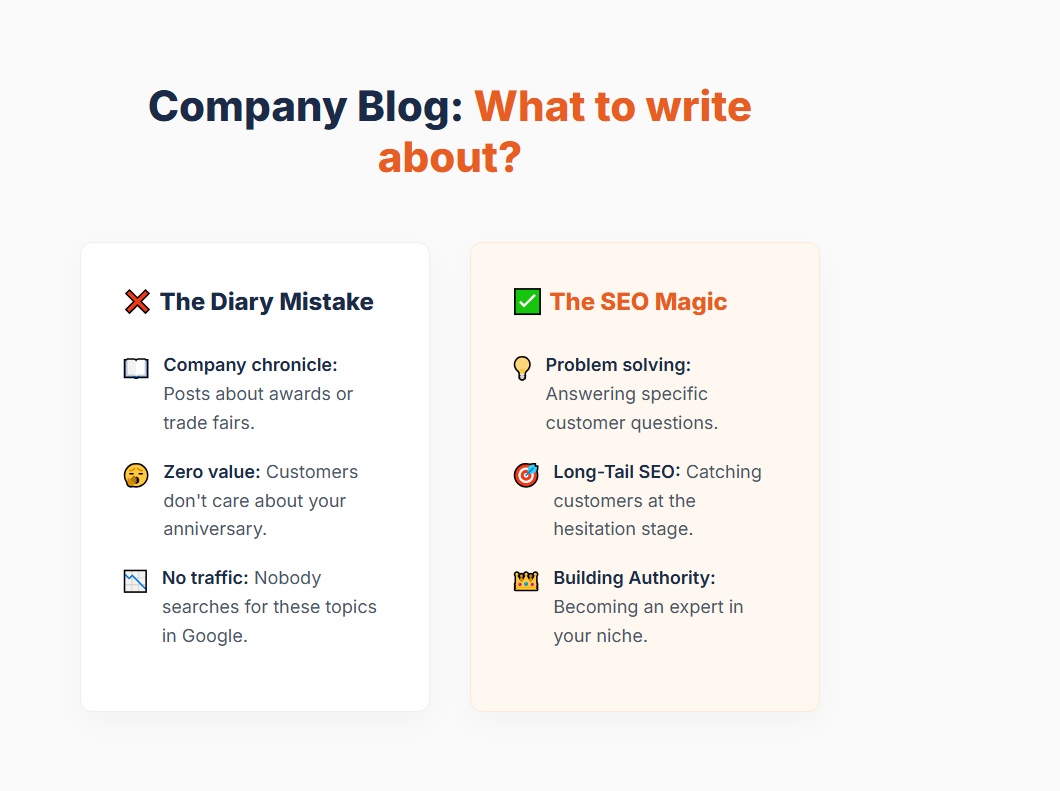
Magic: Writing a blog that solves problems (Long-Tail SEO)
A blog only starts paying for itself when it becomes a free advice center for people who are in your target group.
In marketing, we call this “Long-Tail SEO”. Customers often type educational questions into Google before making a purchase (or calling a professional).
Instead of positioning yourself only for a difficult keyword: “Heat pump installation Poznań”, you use the blog to catch customers at the hesitation stage. You create articles for specific questions from the search engine, e.g.:
– “How much electricity does a heat pump use in an old house?”
– “Heat pump funding 2026 – which program to use?”
– “Why is the heat pump noisy at night?”
Why does this strategy work?
- You Build Authority: When a customer lands on your comprehensive article, where you matter-of-factly explain their problem (without forcing your offer), the thought arises in their head: “This person really knows what they are talking about.” You become an expert.
- You Eliminate Objections: Many people postpone buying an expensive service because they are afraid of something (e.g., that renovating a bathroom will take a month). An article “How long does a step-by-step bathroom renovation really take” kills these fears and speeds up the purchasing decision.
- Less Competition: Hundreds of law firms fight for a position in Google for the word “lawyer Warsaw”, spending tens of thousands of zlotys on agencies. But for the first place for the phrase “what to do when my neighbor flooded my apartment and I don’t have insurance warsaw” barely a few of them fight. If you write a solid guide about it, you will land in 1st place completely for free.
When does a blog NOT make sense?
If you operate in the so-called “rescue” or emergency services industry, where purchase intent closes in a few seconds.
– If you are a tow truck / roadside assistance, a person standing with a broken bumper on the highway is not looking for an article “7 ways to relax in a car waiting for a tow truck”. They are looking for a clickable phone number.
– If you are a 24h locksmith, a blog is less important than a lightning-fast loading page with a price list and a contact section.
In such industries, you should focus 95% of your budget and attention on Google Ads, optimizing your business card in maps (Local Pack), and page speed.
Summary
A company blog is not a news chronicle, it’s a long-term investment. Writing makes sense if you respond to specific pains and fears of customers related to the specifics of your work. Publish less often (e.g., once a month), but let them be comprehensive guides that you will sign with both hands. After 12 months, you will create a knowledge library that will attract new people from the search engine to your website day and night.