
Most small service businesses offer a wide range of services. A plumber can install a bathtub faucet, but can also design and execute an entire installation in a new house. An accountant can handle simplified accounting, but also conduct a tax audit for a limited liability company.
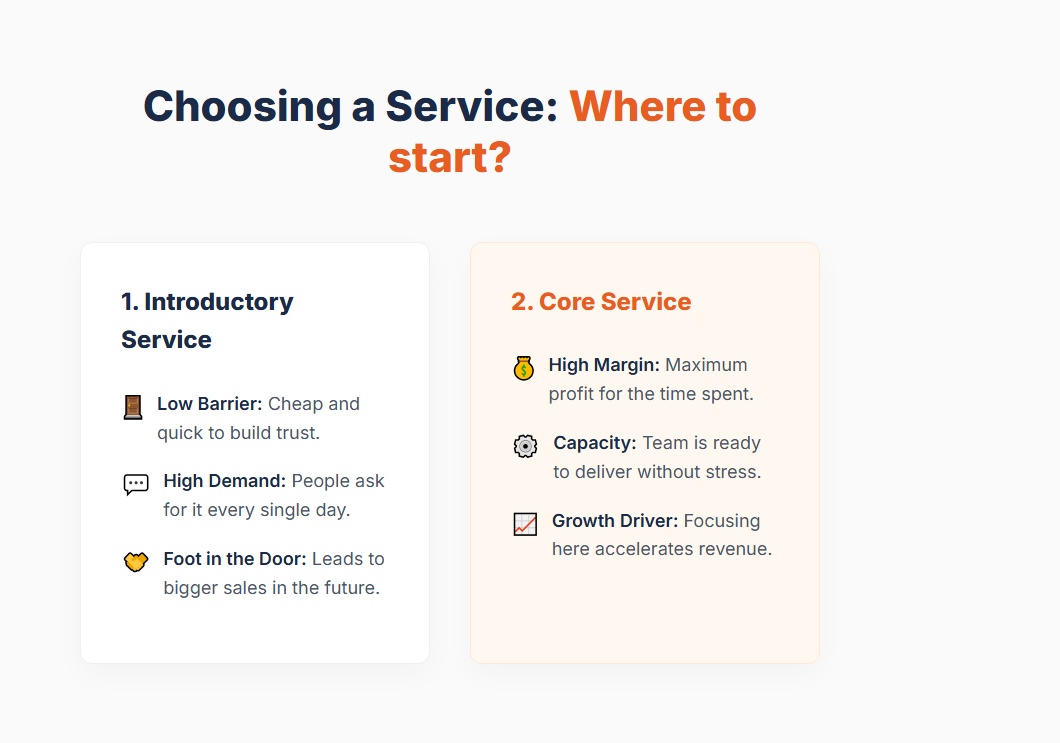
When the time comes to invest in advertising, the owner often decides: “let’s promote everything”. Let’s put fifteen bullet points of what we do on a flyer or a Facebook post. The result of this is easy to predict – the recipient’s attention is distracted and the campaign does not bring profits. The secret lies in choosing one introductory service or the most profitable core service. How to select it? Run your offer through the “sieve of three questions”.
Question 1: Which service has the highest margin and the best time-to-profit ratio?
Focusing marketing around a cheap, low-profitability service that takes a ton of time is the path to burning out the team and the budget.
Example: if you run a car wash (so-called auto detailing), basic interior cleaning can be very time-consuming, and your net profit is 40 PLN. On the other hand, washing with polishing and applying a ceramic coating is a service from which you are left with 800 PLN in your pocket with a similar amount of work.
Marketing (advertising on Google or FB) costs money. If acquiring a customer costs you 60 PLN, in the first case you are losing money on the business. In the second – you get a great return on investment (ROI). Choose to promote those pools of tasks on which the company earns the fastest and best.
Question 2: What do people ask about most often? (Market demand)
The ideal service to promote is one where a high margin meets a high, easy-to-generate demand. If a service is incredibly profitable, but on the local market only two people a year ask for it, even the best marketing budget will not create demand out of thin air (it would require a massive educational campaign, which small businesses rarely have the funds for).
Conversely: there is a type of “door service” (so-called welcome services) that people ask about every day. They are relatively cheap, but they open the door to the customer for you. If, for example, you sell and install heat boilers (an expensive and rare core service), promote a quick, cheap annual gas furnace service at the start. The customer uses a small, quick service – you gain their trust, you enter their contact database and you know that in 3 years they will need new equipment.
Question 3: What is your current processing capacity?
Imagine that the advertising campaign works perfectly and tomorrow you get 15 new inquiries for the promoted service. Are you able to handle them while maintaining the highest quality? Will your team explode under the excess of duties?
Many business owners make the mistake of promoting the most organizationally difficult services at a time when they are understaffed. If you know that a specific repair or service requires the best professional, and that professional is on vacation, direct the budget to simpler tasks that junior specialists can handle without supervision. Your operational capabilities must keep up with the marketing machine.
Summary
Choosing a service to promote should never be a decision made randomly and on a hunch. Make a table on a piece of paper, enter your main services and rate them according to the three criteria above: profitability, demand and processing capacity (on a scale from 1 to 5). The one with the highest score should receive 80% of your budget and your attention starting tomorrow!