
When I ask small business owners where they get most of their clients, the answer is usually the same: “Mainly from referrals, marketing doesn’t really work for us”. This is fantastic news because it means you deliver quality. But basing your business entirely on word of mouth has one gigantic flaw: you have no control over it.
Referrals are wonderful, but you can’t push them like a button on a machine when you suddenly need to increase revenue by 30%. If you want to grow your company steadily, you must build your own predictable client acquisition channels. How to do it? Below you will find a three-step process.
Step 1: Capturing ready demand (Visibility in Google)
The best clients are those who already have a problem and are actively looking for a solution. If someone types “plumber pipe leak” or “garden design Warsaw” into Google, they don’t want to read long articles – they want a quick service.
Your first goal should be to get in their way:
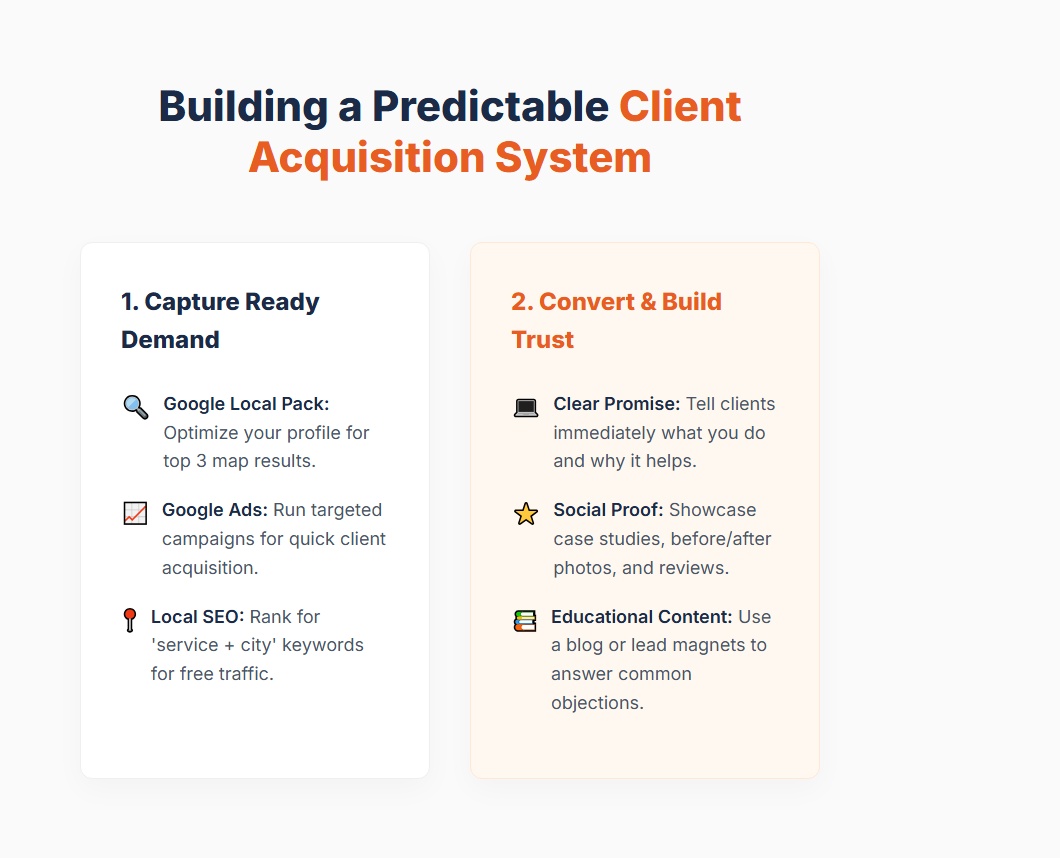
– Google Business Profile (Local Pack): Make sure you have an optimized listing that pops up in the top three on maps. It’s free and generates the warmest leads.
– Google Ads: If you want clients “for tomorrow”, launch a simple text campaign for strictly selected keywords (e.g., only those related to repair, with location).
– Local SEO: It’s a long-term process, but every “service + city” phrase where you are in the Top 3 means free inquiries every month.
Step 2: Converting traffic into inquiries (Website)
You got the click. What now? Website traffic won’t pay your bills if people don’t pick up the phone. Your website must act like your best, most patient salesperson.
For client acquisition through the website to be effective, you must take care of:
– Promise in the headline: Right after entering, the client must know what you will do for them and why it will help them.
– Social proof: Before/after photos, case studies of solved problems, logos, and above all, reviews in the form of a widget or video.
– Clear Call To Action (CTA): One specific step the client should take. Don’t overwhelm them with options. “Call for a free quote” or “Book a consultation date”.
Step 3: Building trust with the undecided (Content and education)
Only about 3% of people are ready to buy at any given moment. What about the remaining 97%? They are considering, researching, looking for information. If you catch them now, you’ll be their first choice when they mature to a decision.
This is where content comes to the rescue:
– Company blog: Answer the most common client objections and questions (e.g., “How much does a heat pump cost in 2026?”, “How to prepare for a photo session?”).
– Social media: Instead of throwing dry promotions, show your backstage. What work on a construction site looks like, how you secure goods, what problems you solve “from the kitchen”.
– Lead Magnet: Offer a free e-book, checklist, or guide (e.g., “10 mistakes when collecting an apartment from a developer”) in exchange for an e-mail address. Later, build the relationship through a newsletter.
Summary
Transitioning from the “I live on referrals” model to the “I have a repeatable sales system” model requires a shift in thinking. You don’t have to do everything at once. Start with the foundation – Google listing and structuring the website so that it answers the client’s needs. Once this engine starts working, gradually add fuel to it in the form of educational articles and paid ads.